The problem is not that manual planning does not work.
The problem is that banking has changed faster than planning practices have.
The real cost of manual planning does not appear as a budget line or a technology expense. It shows up in delayed decisions, fragmented views of reality and leadership teams forced to debate numbers instead of steering the bank forward.
At this point, planning still feels under control.
It no longer supports the speed and coordination modern banking requires.
When planning starts to slow you down
Manual planning in banking rarely fails in obvious ways. It usually becomes a constraint gradually, through symptoms that feel operational rather than strategic.
If you work in planning, controlling, risk or finance, some of these situations will feel familiar:
- Planning cycles take longer each year, without clear bottlenecks
- Scenario requests increase, while response times stretch
- Errors surface late, often during consolidation or reporting
- Teams work in parallel, yet alignment requires constant reconciliation
- Decisions are postponed, not because insight is missing, but because confidence is
None of this points to a lack of competence or effort. These are the natural symptoms of planning processes that rely on manual coordination in an environment that now demands speed, consistency, and frequent change.
Taken together, these symptoms mark the point where planning stops supporting decisions and starts delaying them.
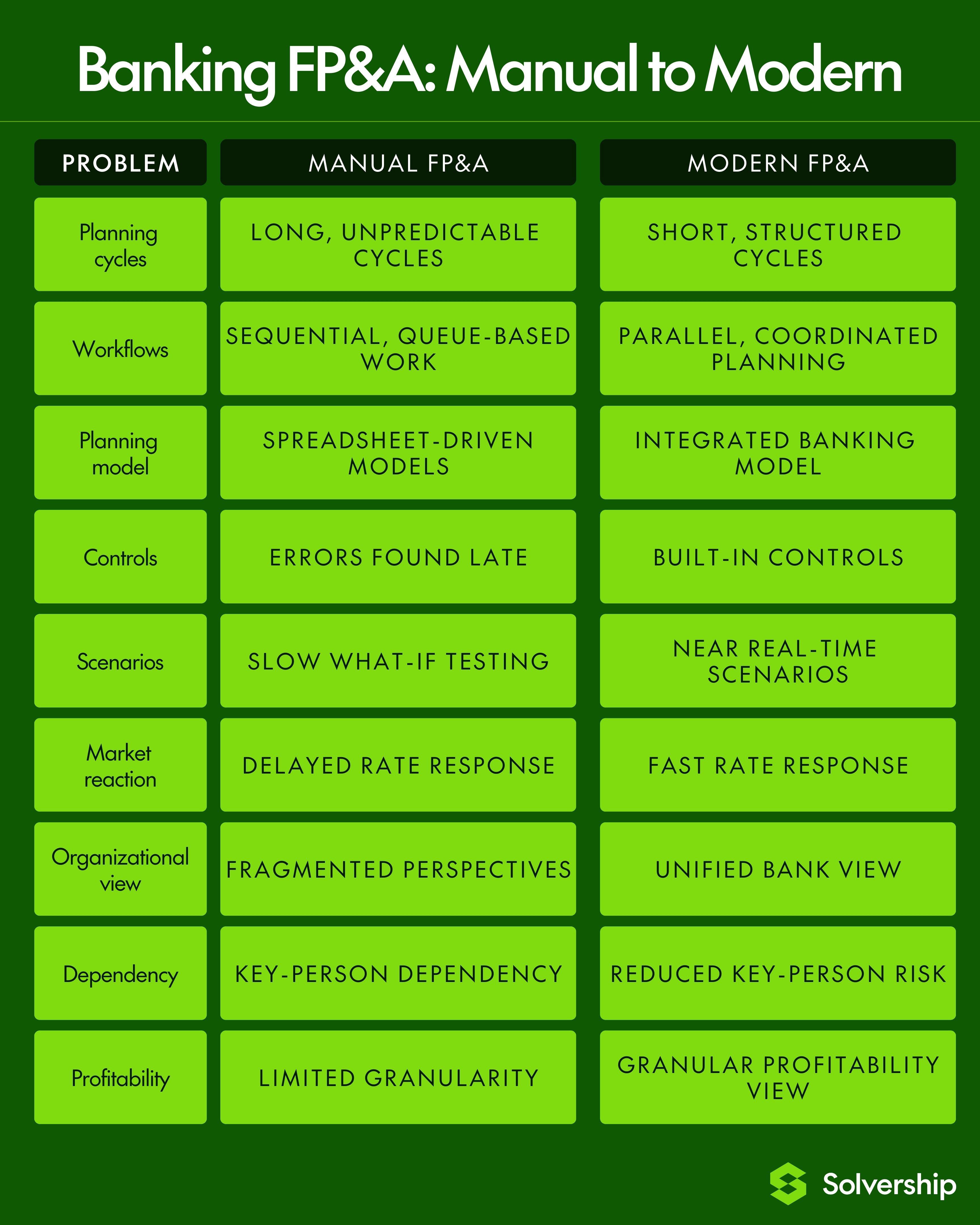
Manual planning is not the problem. Context is.
Manual planning has enabled banks to meet regulatory requirements, manage budgets and maintain control with a high degree of precision for years. That foundation should not be dismissed.
What has changed is the context in which planning is expected to operate.
Banks now operate in an environment shaped by interest rate volatility, tighter capital and liquidity management, increasing regulatory complexity, and higher expectations for transparency. Planning is no longer a periodic reporting exercise. It is a continuous input into decision-making.
This shift is felt differently across the organization. In group reporting and controlling functions, it translates into more iterations, tighter deadlines, and increasing reconciliation effort. In the Corporate and Retail business areas, it means faster pressure to explain performance and adjust targets. At the executive level, including the CFO and other managers, decisions must be taken based on forward-looking assumptions, not consolidated history.
In this environment, even well-built manual models introduce friction precisely where speed and coordination matter most.
The cost of timing in banking
In banking, timing is not a detail. It is often the difference between shaping outcomes and reacting to them.
Interest rate movements, liquidity conditions and market signals evolve continuously. The value of planning lies not only in being correct, but in being relevant at the moment decisions are made.
When scenario updates depend on manual consolidation and reconciliation, the delay is felt throughout the bank. Controllers and accountants spend more time validating numbers. Business users wait longer for answers to pricing or performance questions. Executive discussions take place with partial visibility into capital, profitability and risk implications.
Decisions are rarely wrong.
They are simply made too late.
By the time options reach the CFO and management table, some of them are already constrained, with direct consequences for pricing, capital allocation and risk exposure.
This is where manual planning becomes a strategic issue.
When perspectives multiply, clarity disappears
Manual planning in banks often evolves independently across functions. Group reporting, Risk, Treasury and business units maintain separate models, assumptions and timelines.
Each perspective is valid within its domain. The challenge emerges when alignment depends on manual reconciliation.
What begins as operational complexity gradually becomes leadership friction. Controllers struggle with version control and late adjustments. Business units question centrally produced forecasts. Senior management meetings shift toward validating numbers instead of defining direction.
Without a shared and consistent view of the bank, planning becomes coordination instead of leadership.
Clarity does not disappear because expertise is lacking. It disappears because the framework does not support integration across roles.
What modern FP&A delivers in practice
When banks move to an integrated Financial Planning & Analytics (FP&A) model, the impact is tangible and measurable.
FASTER AND MORE RELIABLE PLANNING CYCLES
Planning cycles become predictable and significantly shorter. Budgeting, rolling forecasts and scenario analysis follow a structured process rather than a chain of manual handovers. Planning runs in parallel across functions, not sequentially.
PARALLEL PLANNING WITHOUT BOTTLENECKS
A common limitation of manual planning is sequential work. One unit finishes, then another starts. Delays compound quickly.
In an integrated FP&A model, multiple business units plan simultaneously, using the same underlying drivers and assumptions. Retail, corporate, treasury and support functions work in parallel, without waiting for handovers or reconciliations.
The result is:
- Shorter planning cycles without loss of control
- Fewer dependencies between teams
- Immediate visibility into how individual plans impact the whole bank
Planning shifts from a queue-based process to a coordinated workflow.
INTEGRATED REPORTING AND CLEAR PLAN VS ACTUAL COMPARISON
An often overlooked benefit of FP&A in banking is the simplicity of reporting.
With a modern FP&A system, reporting is not produced separately in Excel and then manually compared with plans. Actuals are pulled directly from the central database, and Plan vs Actual comparison becomes a native capability of the system.
Instead of exporting reports from the database and reconciling differences across spreadsheets, banks work in a single environment where planning and reporting follow the same data logic.
The result is:
- Immediate and consistent Plan vs Actual comparison
- One source of truth across planning and reporting
- Less reconciliation effort
- Greater confidence in management discussions
Reporting stops being a separate exercise and becomes an integrated extension of planning.
REAL-TIME WHAT-IF SCENARIOS AND FORECASTING
Leadership gains the ability to run what-if scenarios in near real time. Changes in interest rates, volumes or margins immediately show their impact across profitability, capital and liquidity. This supports continuous forecasting instead of static annual plans.
MEASURABLE OPERATIONAL EFFICIENCY
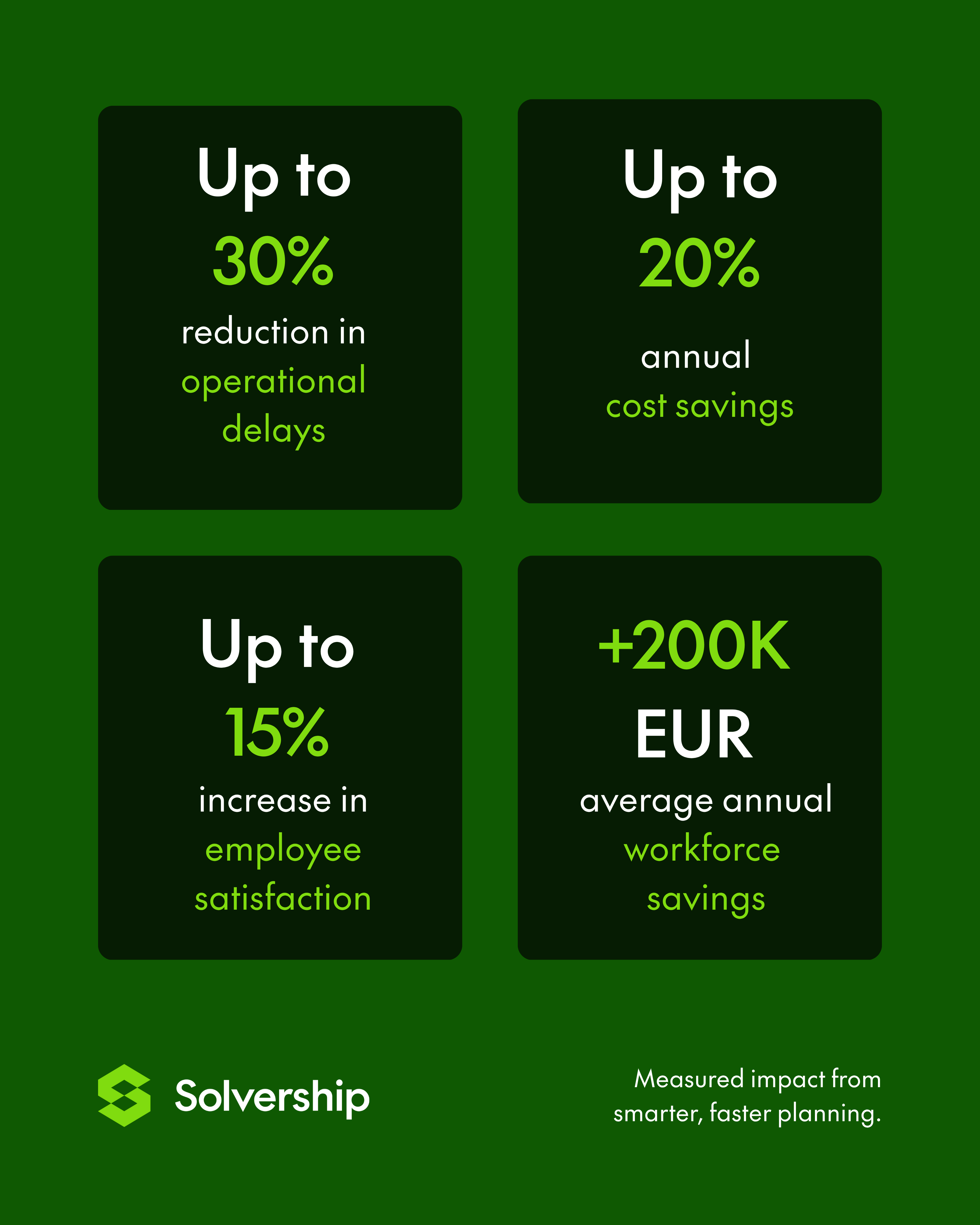
Automation and redesigned processes typically free the equivalent of three or more full-time employees from manual data preparation, reconciliation and model maintenance.
In mid-sized banks with more than 1,000 employees, this often translates into annual workforce savings exceeding 200,000 EUR, while improving engagement within finance teams.
GRANULAR PLANNING WITHOUT LOSS OF CONTROL
Banks gain the ability to plan at a granular level, down to branches, products or customer segments, while maintaining governance, transparency and consistency across the organization.
Decision-making supported in real time
At the core of modern FP&A is a digital twin of the bank.
Instead of static models, leadership works with a structured representation of how key drivers interact across profitability, capital and liquidity. Changes in interest rates, volumes or assumptions immediately show their impact across the institution.
This enables:
- near real-time what-if scenarios
- fast reaction to market changes
- consistent impact analysis across functions
- faster, more confident executive decisions
Discussions shift from validating numbers to evaluating options.
A banking planning model built for real-world implementation
What differentiates our approach is not only what the model can do, but how it is delivered.
Our FP&A solution is built on a predefined banking planning model that reflects how banks actually operate across P&L, balance sheet, portfolios and risk-related drivers. This reduces implementation complexity and time-to-value.
Instead of long design phases and extensive custom development, banks start from a proven structure and adapt it to their specific products, portfolios and organizational setup.
The approach combines a predefined banking model, fast implementation and the ability to plan in parallel, without forcing banks into long and costly transformation programs.
Planning as a leadership capability
The true value of modern FP&A in banking is not faster budgeting cycles.
It is stronger leadership under uncertainty.
When assumptions are transparent, scenarios are consistent and impacts are clearly visible, leadership regains confidence in planning as a decision tool. Finance, risk and business teams operate from the same logic, using planning as a shared language rather than a reconciliation exercise.
Planning becomes a capability that supports direction, not just control.
A model built for how banks actually operate
In banking, planning does not need to be reinvented. It needs to be reliable, adaptable and grounded in how decisions are actually made.
Solvership offers a predefined banking FP&A model, fast and controlled implementation, and deep domain expertise, enabling CFOs and controllers to move from manual coordination to integrated, decision-driven planning. The result is planning that supports parallel work, delivers clarity across the bank and enables confident decision-making under uncertainty.
If your planning framework still requires excessive reconciliation, sequential workflows or heavy manual effort to produce insight, the next step is not another workaround.
It is a different planning model.